One In Five Australian Children Have Already Had a Bad Conversation with an AI Bot
Important Dates
Principal's Message
Melbourne RSC Companions
The Religious Sisters of Charity Companions is a group that comes together 4 times per year. We connect with our Catholic faith tradition that inspired Mary Aikenhead’s faithful and courageous response to God’s call. From the Sisters of Charity website:
As Companions, we gather and explore ways in which to continue our links to the rich history of the Sisters.
As RSC Companions, we are inspired by the spirit, dream and life of Mary Aikenhead, foundress of the Sisters of Charity, and the unfolding of this dream over two centuries.
We support one another by friendship, prayer and our endeavour to show Christ’s compassion to all, ever aware of, and responsive to the changing needs of the times.
This past Sunday the Companions gathered at St Columba’s College for the annual Companions retreat day. This year we were gently led in a reflection on the Beatitudes, Jesus’ call for us to be people of love, hope, justice and compassion. From the Gospel of Matthew 5:1-12:
When Jesus saw the crowds, he went up the mountain; and after he sat down, his disciples came to him. Then he began to speak, and taught them, saying:
“Blessed are the poor in spirit, for theirs is the kingdom of heaven.
“Blessed are those who mourn, for they will be comforted.
“Blessed are the meek, for they will inherit the earth.
“Blessed are those who hunger and thirst for righteousness, for they will be filled.
“Blessed are the merciful, for they will receive mercy.
“Blessed are the pure in heart, for they will see God.
“Blessed are the peacemakers, for they will be called children of God.
“Blessed are those who are persecuted for righteousness’ sake, for theirs is the kingdom of heaven.
“Blessed are you when people revile you and persecute you and utter all kinds of evil against you falsely on my account. Rejoice and be glad, for your reward is great in heaven, for in the same way they persecuted the prophets who were before you.
Taken from the Sermon on the Mount, the Beatitudes embody Jesus’ vision of what it means to live fully human lives – a template of living. They call for a disposition of heart and mind, as we respond to God’s presence within us, and as we bring God’s presence to those around us. The Beatitudes are blessings – lives lived through the lens of the Beatitudes are a gift we offer to our family, our communities, and our world. Shaun Dowling-Horgan, one of our Companions leaders, offered this beautiful reflection as part of our retreat.
Beatitudes of Life Blessing
“Blessed are the poor in spirit, for theirs is the kingdom of heaven.”
– Matthew 5:6
The beatitudes can be a pathway to deep joy and life-giving purpose. Blessed are you:
when you empty your hands of clutter – may you be open to receive the gifts before you;
when you are able to grieve your losses – may God hold and comfort you with tenderness;
when you are gentle with yourself and others, may you walk softly and sensitively this earth;
when you hunger and thirst for goodness – may you live courageously from your heart;
when you are viewing life with mercy – may you be compassionate and forgiving of all;
when your heart is alive with the fire of love – may you be a vessel of loving kindness;
when you seek to be a peacemaker – may you build bridges of reconciliation and connection;
when you are misunderstood and overlooked – may you know that God will be your advocate.
Embracing the beatitudes of life, may you strive to be a living blessing in all your conversations and actions, empowered by your loving God, who is the source and inspiration of every blessing.
Shaun Dowling-Horgan 2026
Prayer
Vinnies Winter Sleepout, Justice in Action
Our upcoming Vinnies Winter Sleepout on 4th Sep invites our community to do more than experience a cold night. It asks us to encounter, in a small but meaningful way, the reality faced by people experiencing homelessness and housing insecurity, and to consider how our faith calls us to respond.
Catholic Social Teaching reminds us of the dignity of every human person and calls us to a preferential option for the poor. In the Gospel, Jesus continually goes to the margins, drawing close to people who are overlooked, excluded or vulnerable. His words challenge us: “Whatever you did for one of the least of these brothers and sisters of mine, you did for me.” Matthew 25:40.
This same call lies at the heart of our Mary Aikenhead Dimensions. Mary Aikenhead understood that the love of Christ must become visible through compassionate and courageous action. She calls us to be contemplatives in action, attentive to the needs around us and willing to be extensively useful in responding to them.
The Winter Sleepout is therefore more than an event. It is an opportunity to listen, learn and act. As we sleep out, raise awareness and support the work of Vinnies, we are invited to ask what Justice requires of us, not only for one night, but in the choices we make and the way we recognise the dignity of others each day.
Prayer
Loving God,
You call us to recognise your presence
in every person we encounter,
especially those pushed to the margins.
As we prepare for the Vinnies Winter Sleepout,
open our eyes to the realities of homelessness
and our hearts to those who live without the security of a home.
Inspired by the Gospel and the example of Mary Aikenhead,
help us to be contemplatives in action,
people of compassion, courage and Justice.
May this experience deepen our understanding,
strengthen our commitment to human dignity,
and move us beyond awareness towards action.
Teach us to use our gifts extensively,
to stand alongside those experiencing hardship,
and to make the love of Christ visible
in the way we serve, speak and live.
Amen.
Author: Mr Lance Jilbert, Head of Faith and Mission
Notices from the Deputy Principal
ASSUMPTION MASS
Our College community came together to celebrate the Feast of the Assumption of the Blessed Virgin Mary, honouring Mary of Nazareth as a model of hope, faith and love for us all. It was a particularly reverent and special Mass, enriched by the presence of several Sisters of Charity and other guests who joined us for this important celebration. Thank you to our Head of Faith and Mission for the thoughtful preparation of such a beautiful liturgy, and to Fr Bernie Lane for celebrating Mass with us. It was a wonderful opportunity for our community to pause, reflect and celebrate Mary’s enduring example of faith, courage and trust in God.
VISITORS FROM SHIN-AI, JAPAN
We were delighted to welcome students from our sister school, Shin-Ai, in Japan to the College recently. A wonderful thank you to Hannah Koyama and Makoto Hirabayashi who worked so thoughtfully to plan and coordinate the program, and to the families and students who generously welcomed a visiting student into their homes. These experiences provide our students with a valuable opportunity to develop cultural understanding, build friendships and gain a genuine insight into life in another country. It was wonderful to hear such positive feedback from both our students and our visitors, who spoke about how much they enjoyed the program, the opportunity to connect with one another and the experiences they shared during their time together. We are grateful for this ongoing partnership with Shin-Ai.
30 60 90 PARENT INFORMATION NIGHT – Monday 10 August
Thank you to the approximately 100 parents who joined us online to hear more about our new learning structure for 2027 and the 30 60 90 timetable. It was wonderful to have such an engaged audience, with some great questions and encouraging feedback, including: “This initiative sounds exciting and I’m looking forward to the implementation of it.” As always, we encourage families to visit the 30 60 90 Hub for further information about the new learning structure and to stay up to date with information relating to this initiative.
2027 PARENT INFORMATION NIGHT – Wednesday 12 August
On Wednesday 12 August, we welcomed our 2027 Year 7 students and their parents to our Year 7 Parent Information Night. It was a wonderful opportunity to begin building the partnerships that will support our newest students as they commence their six-year journey with us. As part of the evening, our incoming Year 7 students participated in a Languages Taster Program, giving them the opportunity to experience Italian, French and Japanese before making their language choice for 2027. A big thank you to our Languages Team for creating such engaging and enjoyable activities for the students and to the current Year 7 students who provided wonderful service to our community by attending the evening to support the taster program.
Thank you also to the staff who provided our parents with relevant and timely information throughout the evening. A special thank you to Adam, a member of our Parent Engagement Team, who spoke so beautifully about the partnership between families and the College, the sense of connection that this creates, and the many benefits this partnership brings to our children.
We look forward to continuing to build these strong partnerships with our 2027 Year 7 families as they prepare to join our College community.
CHILD SAFE COMMITTEE MEETING – Tuesday 18 August
There has been a strong focus on child safety, wellbeing and respectful relationships across the College this term.
Staff have continued their professional learning through the 11 Months, 11 Standards program, with a focus on Child Safe Standards 6, 7 and 8, alongside professional learning in student behaviour management, and future sessions on duty of care, anaphylaxis and reportable conduct. The AI Ready Project with Matt Esterman and Tim Kitchen has also supported staff in considering safe and responsible use of AI.
Planning is underway for National Child Protection Week (6–12 September), with this year’s theme, Every Conversation Matters: Shifting Conversation to Action. Our students and staff will be involved in activities that encourage students to know their supports, speak up, look out for one another and stay safe online. Thank you to our SWAT Captain and team who have already been developing posters and student-led resources for the week.
We have also been preparing for the updated PROTECT Protocols, which provide clearer guidance for responding to concerns based on the source of the concern, including concerns involving adults engaged by the school, students, family members or others in the community. A stronger emphasis is also placed on documenting actions taken in response to a concern.
Our pastoral care program continues to provide age-appropriate learning across Years 7–12, including child safety, respectful relationships, emotional wellbeing, consent, online safety, mental health and strategies for navigating relationships and challenging situations.
We thank our staff, students and families for their ongoing commitment to creating a safe, respectful and supportive College community.
CHILD SAFETY – Update about The Orange Door
Our school cares about the safety and wellbeing of our students and their families. Sometimes things at home or in a relationship are not OK, or families can be worried about the wellbeing of their children or young people.The Orange Door can help you to get the support you need, quickly and easily. It’s free and you don’t need a referral.
The Orange Door
The Orange Door can help families. They provide support for concerns with parenting, relationships, and family violence. The Orange Door is a free intake and assessment service for:
families requiring support for their child or young person’s wellbeing or development
families needing parenting support
young, isolated, or unsupported families
individuals and families experiencing family violence
adults using family violence
young people using violence in the home.
If you contact The Orange Door, they can help by:
working with you to identify the help and support you need
supporting you with the wellbeing and development of your child or young person
helping you make a safety plan if someone is making you feel unsafe
connecting you to services that can help like counselling, accommodation, mental health and drug and alcohol services, parenting support groups, services for children, financial help, or legal assistance
supporting you to access funding for basic living expenses and some other costs
supporting you to change abusive or controlling behaviour.
Each Orange Door location across Victoria has their own phone number and email. Students and their families can also visit their local Orange Door in person for support, Monday to Friday, 9am – 5pm for support. No appointment is needed.
Our local service operates in Footscray: 265 Barkly Street | wma@orangedoor.vic.gov.au | 1800 271 045
How schools connect with The Orange Door
Our school might talk to a student and/or their family about The Orange Door. We might encourage them to contact their local Orange Door to get advice and help if needed. Ideally, a student and/or their family will get in touch with The Orange Door to see advice and support. Sometimes, schools might make a referral to The Orange Door without the student or their family’s knowledge or consent. Schools will do this if:
informing a student and/or family increases the risk to their safety or wellbeing
not linking a student to support increases the risk of their safety and wellbeing.
You can learn more about:
The Orange Door and how they can help you and your family here.
PARENT ENGAGEMENT COMMITTEE (PEC)
Every parent in our community is a member of the PEC and we welcome your involvement. If anyone is interested in joining the PEC or learning more about what we do you can join us in person or online – 7.30pm – meet.google.com/fij-hziu-ymk).
Our meeting dates are as follows:
Tuesday 15 September
Tuesday 20 October
Tuesday 17 November
FUNDRAISING
In consultation with the Student Engagement Team, funds raised through the raffle and other PEC initiatives this year will go towards the purchase of an outdoor, weather proof table tennis table for students to enjoy during breaks and lunchtime. This exciting addition will provide another active and inclusive recreational option, encouraging students to enjoy healthy physical activity in a fun and social environment.
ALUMNAE COMMITTEE
Our Alumnae Committee meets once each term on a Wednesday evening from 7:00–8:30pm, working to strengthen and celebrate the lifelong connection between the College and our former students. Through their dedication, the Committee supports opportunities for alumnae to stay connected with one another and with the College community, fostering meaningful engagement with current staff and students and nurturing a lasting sense of belonging.
If you are an alumna and would like to become a member of the Alumnae Committee, please contact alumnae@columba.vic.edu.au. Our next meeting for is scheduled for Wednesday 14 October.
Spring Market
On Sunday 13 September: 9am-1pm the St Columba’s Alumnae will host their second market. Held at St Columba’s College Essendon, entry via Buckley St, in the MPC. Come along and browse over 40 stallholders offering gifts, homewares, jewellery, clothing and handmade items. Visit the PEC BBQ for a sausage in bread or enjoy a Slushy, fresh popcorn and fairy floss.
Author: Ms Brigitte McDonald, Deputy Principal
Wellbeing Spotlight: The Art of Enough
The Victorian Parents Council wellbeing series explores how we can support young people to develop healthy and sustainable approaches to wellbeing. The article “Exercise, Capacity and the Art of Enough” reminds us that wellbeing is not about constantly doing more, but about recognising our limits, finding balance and making choices that support our physical and emotional health.
Exercise is important for confidence, resilience and overall wellbeing, but it should be enjoyable and achievable rather than another source of pressure. Small moments of movement, rest and connection can make a meaningful difference.
On Thursday, the 20th of August, St Columba’s had the privilege of hosting the Year 6 cohort of the primary school, St Oliver Plunkett, in the new Foxford Innovation Centre to deliver waste and energy themed activities, and to share our Precious Plastics initiative.
To begin the day, class 6F explored the many uses of recycled plastics, the importance of reducing waste as well as repurposing waste into useful products. To solidify this, the students sorted, shredded, and melted down bottle caps collected by St Columba’s students to create their very own spinning tops, earrings, and keychains, unanimously concurring that “it was really good” and that they “loved it”. They discussed the ways they can reduce, reuse, and recycle items they previously would’ve discarded, describing this session as “amazing”. After completing this activity, the students reflected that “you can recycle plastic and use it to make different things”, and that with “different types of plastic, you can’t mix them”
While class 6F worked with Precious Plastics, class 6N worked with members of St Columba’s Green Team to scrutinise energy usage, the origins of energy, and different forms of energy. They created rubber-band-powered cars and noted that “by putting elastic bands on the wheels too, it gave more traction,” “friction in the carpet slowed down the car”, and that you “don’t always need to use motor energy to power vehicles”. When the majority of students were creating these cars, individual groups participated in the Energy Escape Room. This activity had them complete five activities, working together to develop and reinforce their understanding of energy through puzzles such as locating the room’s energy-using appliances and ranking them by energy usage, as well as recreational games like unscrambling energy-related words. The students agreed that the escape room “was so much fun” and that what helped them was when they “tried different things, and worked together”. After the two classes completed their first activity, they swapped so that class 6F worked with the Green Team, and class 6N explored the Precious Plastics Program.
Ultimately, the “really fun” sustainability workshop taught the Year 6s how to be more aware of the different types of energy and material in their everyday lives, and to make conscious decisions on how they consume these resources.
Author: Written by Imogen, Year 10
Sports News: Soccer
On the 19th of August, we had our Soccer girls head to the CGSAV Soccer competition in Darebin. It was a very cold and windy day, however this wasn’t enough to dampen the girls spirits. The girls all played with enthusiasm and demonstrated team spirit. Although we might not have gotten the result we wanted, the girls still showed off their skills and played well across the whole day.
A special shout out goes to our 3 student coaches, Mia V, Chelsea A and Chloe C for putting in the work helping our teams for the day and providing lots of encouragement for their teams.
Congratulations again to all the girls for their hard work!
Author: Sports Department
Kick Arts Recap 2026
On Friday 21st August, Kick Arts 2026 brought together students from St Columba’s College, St Bernard’s College, and Ave Maria College for a celebration of creativity, talent, and overall, the performing arts. Each school competed across four categories: dance, drama, music, and singing. There was a fantastic variety of performances throughout the night, showcasing a blend of music, cultural expression, and creative storytelling. From music ranging from Franz Ferdinand to Michael Jackson, to vibrant cultural dance, and a creative drama performance combining Little Red Riding Hood and Cinderella, the night highlighted the incredible diversity of talent across the three schools. A special congratulations goes to Dior P from St Columba’s who took home the dance award for an outstanding performance! The college is incredibly proud of all the students who participated as it was wonderful to see the talent and creativity of the students continue to bloom in such remarkable ways.
Thank you to all staff, students, and everyone involved in Kick Arts 2026 for such a memorable event!
Author: Written by Arpita S, Arts Captain
Urban Experience Recap
Last week, my classmates and I had the privilege of attending Urban Experience with St Bernard’s College, where we were placed in groups with the boys and got to explore the city and complete activities throughout the week. This experience not only helped me gain more confidence in using public transport and exploring the city independently, but I was also able to witness the college values in real life and learn about my city’s past, present and future. Our typical day included a range of group and class activities which each brought me new, incredibly useful knowledge, but some that stood out to me were the Frontyard Services session, the Ian Potter Centre activity and the Street Art Walk.
The Frontyard session included a presentation on homelessness in Melbourne, specifically the dangers of living without a home, the places homeless people are forced to resort to, the different causes of homelessness and the help that is available for them. I think this session really stuck with me because it reminded me how privileged I am, as I live in a situation where these struggles never even cross my mind. It made me aware of just how different other people’s lives are to mine and how quickly someone’s life can change. The Ian Potter Centre also educated me on the past and present of Indigenous peoples and their different expressions of artwork, which I really enjoyed seeing and learning about. Each artwork was different and represented diverse artists, helping me to see how people can show their stories and culture through art in many different ways. Finally, I personally felt most connected to the Street Art Walk, as every street we went down during the activity was covered in different artworks and drawings made by all kinds of people. To me, that represented the fact that despite how different these people may have been, they were all able to express themselves through art in the same shared space. I also felt that it represented the diversity of Melbourne and how our city is made up of many different backgrounds, cultures, beliefs and people, yet we are united by our shared city and our freedom to express ourselves within it.
My experience at Urban is something that I will cherish and remember for a long time, as it not only gave me valuable knowledge through experiencing the city myself, but also gave me new friendships and new perspectives. Each of the different activities gave me something meaningful to take away, whether it was a greater understanding of homelessness, Indigenous culture, Melbourne’s diversity or simply learning how to navigate the city more independently. Most importantly, Urban helped me to view the world with greater compassion, hope, justice, love and truth. Getting to know the people in my group was also something that I truly appreciated, and I hope to hold onto the friendships I made for a long time.
Author: Written by Isabel M
Mooting Competition Recap
Year 11 Legal Studies students attended Deakin University to undertake a Mooting Competition against other schools. The competition required them to develop legal arguments and reasoning relating to a case appealed to the High Court. All students received awards for their advocacy skills and did a phenomenal job.
Author: Ms Emma Hassan, Cahill House Leader
Tournament of The Minds Competition Recap
On Sunday, August 16th, some of our LEAP students competed alongside schools from across Melbourne in the annual Tournament of the Minds competition, held at Deakin University, Burwood.
These students spent several weeks preparing two challenges; a Long term challenge and a Spontaneous challenge. Our teams prepared their Long-term challenges in the categories of Social Sciences and STEM. The Social Sciences teams were asked to explore, research, design and present an original proposal to address the serious economic and ethical questions surrounding the Fast Fashion industry, while the STEM team researched, designed and presented an original proposal for a Science Fiction film that incorporated STEM principles and addressed a critical scientific issue.
In the Spontaneous challenge, our teams were required to work collaboratively and think on their feet to solve an unexpected problem within a strict time limit.
All of our teams worked closely and collaboratively to explore, design and present outstanding presentations that demonstrated creativity, curiosity and original thinking.
Author: Ms Sonia Rocco-Redvers, Learning Enhancement Leader
Thriving Minds and Senior Stretch Recap
On July 30th and 31st, five Gifted and Talented students from Year 10 and our LEAP students from Years 7 to 9 participated in the Thriving Minds symposiums at La Trobe University (Senior Stretch) and Camberwell Grammar School (Junior Thinkers). These events are aimed to challenge and extend our students in the LEAP (Learning Enrichment Accelerated) program.
At the Senior Stretch symposium, senior students contended with challenging questions in a series of interactive lectures about rules, knowledge, technology, individual freedom and human experience — exploring issues of responsibility, truth and what it means to live purposefully. Students enjoyed fascinating lectures from Oxford University scholar, Julie Arliss and a live streamed lecture from Oxford University lecturer, Dr Chris O’Neill who explored the riveting topic of ‘Music, the Brain and Healing’. Our students explored profound concepts and were challenged to test ideas that touch every part of human life.
At the Junior Thinkers Conference, our students focused on developing the intellectual foundations that support long-term success: disciplined reasoning, clear communication, curiosity and building the confidence to engage with highly challenging ideas. Students enjoyed the opportunity of working with like-minded students from schools across Melbourne to discuss and analyse ethical and philosophical questions.
The aim for each of the Thriving Minds symposiums was to help our Gifted and Talented students build the confidence and habits of mind that will enable them to flourish intellectually and academically and to explore challenges with real purpose
Author: Ms Sonia Rocco-Redvers, Learning Enhancement Leader
The Great Book Swap
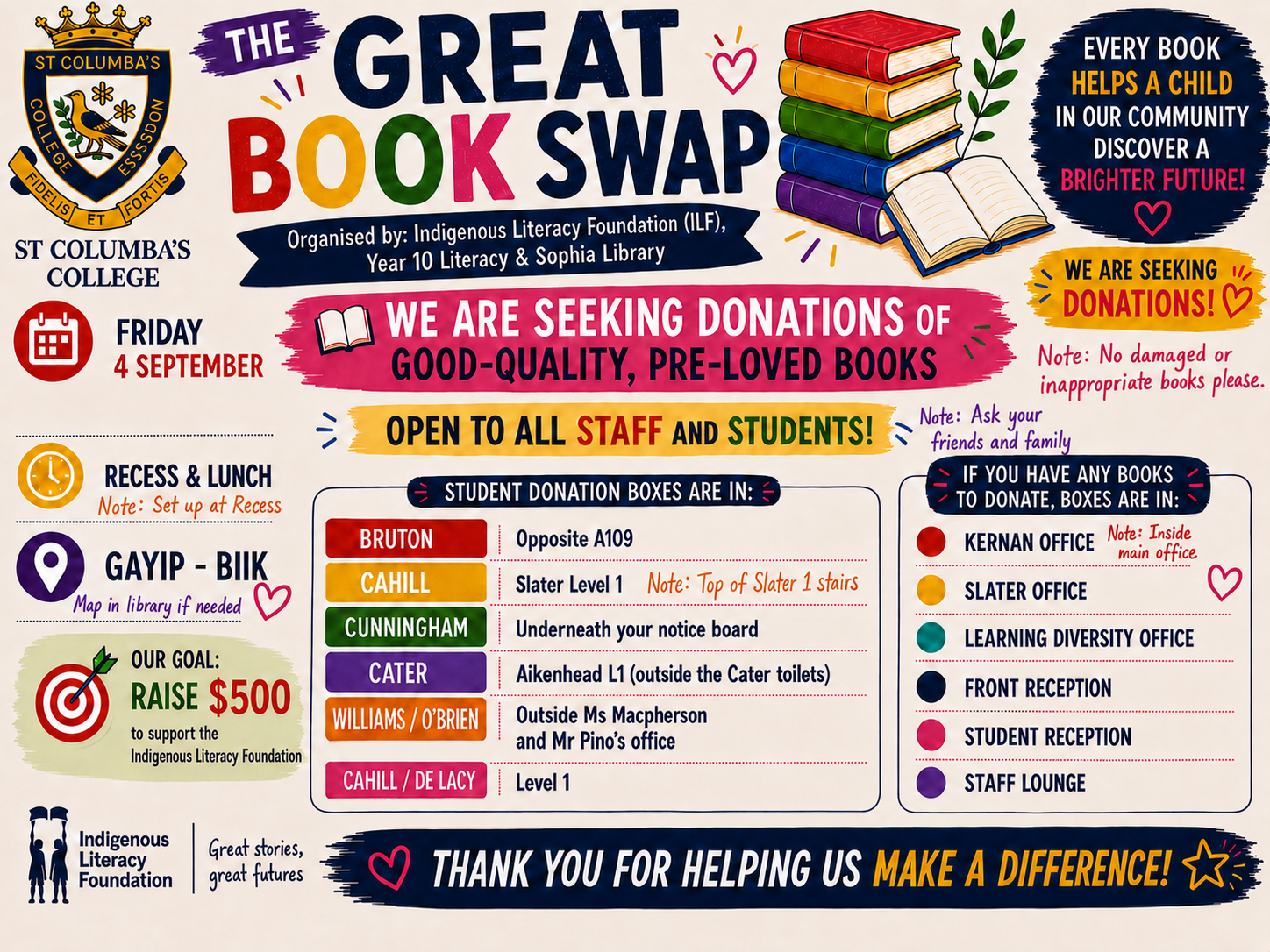
This September, St Columba’s College is excited to be holding The Great Book Swap, a special event organised by the Indigenous Literacy Foundation (ILF), Year 10 Literacy and the Sophia Library.
The Great Book Swap will take place on Friday 4 September during recess and lunch in Gayip – Biik. The event is open to all students and staff, and everyone is encouraged to get involved.
We are currently seeking donations of good-quality, pre-loved books. If you have books at home that you no longer read, this is a great opportunity to give them a new home while supporting an important cause. You might also like to ask your friends and family if they have any books they would be happy to donate. Please make sure all donated books are in good condition, appropriate for our school community and not damaged.
Donation boxes have been placed in different areas around the College to make donating as easy as possible. Student donation boxes can be found in the different House areas, and additional donation boxes are available at locations including the Kernan Office, Slater Office, Learning Diversity Office, Front Reception, Student Reception and Staff Lounge.
On the day of the Great Book Swap, students and staff will have the opportunity to browse the donated books, discover something new to read and support the Indigenous Literacy Foundation at the same time.
Our College goal is to raise $500 for the Indigenous Literacy Foundation. The Foundation works to support literacy and access to books for Aboriginal and Torres Strait Islander children and communities.
The Great Book Swap is a wonderful way for our College community to come together, share our love of reading and make a positive difference. Even one donated book can help contribute to the success of the event.
So, have a look through your bookshelves, ask your family and friends, and consider donating any books you no longer need.
We hope to see lots of students and staff getting involved on Friday 4 September!
Thank you for helping us make a difference — every book helps a child discover a brighter future!
Author: Written by Aoife P, Year 10 Student
The Plastic Country Movie Night - FREE Screening
The St Columba’s College Green Team is hosting a special screening of the powerful new documentary The Plastic Country!
Discover: The shocking environmental and health impacts of plastics in Australia.
Engage: Join a lively post-film Q&A featuring local leaders Erin Rhoads (The Rogue Ginger), Moonee Valley Sustainability Group, and Boomerang Alliance!
Act: Walk away with simple, effective ways to protect your family and slash plastic reliance.
Don’t miss a night of cinema, health insights, and community action. See you there!
Wednesday 16 September 2026 7:00 PM – 8:30 PM (UTC+10)
St Columba’s College – Theatrette, 2 Leslie Road, Essendon VIC 3040
– St Columba’s Year 9 Mock Interviews
– Monash University News: Monash Information Evening, Entry Schemes & Bachelor of Business Administration
– Australian Catholic University: Year 12 VCE Revision Webinars & Missing Prerequisites
– Vic Uni: Early Entry
– Swinburne: Early Entry, August Information Sessions & New Courses introduced in 2026
– William Angliss:2027 Course Guides, Final Discovery Day of the Year & School Holidays Program
– RMIT:2027 Course Guides & RMIT UniReady – Bond Uni: Entry
– AIM:Music Theatre Audition Workshop
– Federation Uni: Course Guide & Early Entry – Deakin: Deakin Uni Ready & Deakin Guaranteed ATAR
– Collarts: Open Day
– Melbourne Uni: Course prerequisites for entry to Melbourne, ATAR Guarantees – Torrens University: Early Entry – SAE: Open Day & Create for a day – LCI: Open Day & Diplomas – La Trobe University: September School Holiday Activities & Nexus Program – Whitehouse Institute of Design: SeptemberSchool Holidays Workshops – University of Tasmania: Bachelor of Medical Science and Doctor of Medicine – Future Doctors Australia Program – The Australian Taxation Office School Leaver Program
– Hotel School of Australia – Early Entry Guide
– Open Days 2026
Also, a guide to upcoming September School Holiday Events HERE.
Happy reading! If you require any further assistance, please DM a member of the Pathways team at pathways@columba.vic.edu.au
Author: Ms Rosalba D’Astoli-Iannuzzi, Pathways Teacher
Year 10 2027 Laptop Program
A SEQTA DM with a Google form was sent out to Year 9 parents asking whether they would like to purchase a new laptop or continue with the current laptop for years 2027-2029, the form will be open until 5th October.
Author: Mr Adam Tzemis, Network & Systems Manager
Sophia Library Opening Hours School Holidays
The Sophia Library will be open for the first week of the school holidays to coincide with the VCE Units 3/4 Trial Exams. Hours will be 8.30 am. – 3.30pm Monday to Thursday.
Author: Ms Ngaire Brown, Head of Library
One In Five Australian Children Have Already Had a Bad Conversation with an AI Bot
On Monday 3 August the Australian eSafety Commissioner released its most detailed study yet of how children are using generative artificial intelligence. The report, titled Talking to Machines: Children’s Experiences with AI Assistants and Companions, is based on a survey of one thousand nine hundred and fifty children aged ten to seventeen, conducted between the second of February and the fourth of March 2026.Seventy eight per cent of the children had used an AI assistant such as ChatGPT, Gemini or Copilot. Eight per cent, an estimated two hundred thousand Australian children, had used an AI companion such as Character.AI, Anima or Chai.More than half of all users 54% had turned to the tools for personal or social reasons: advice on situations, physical health, feelings, mental health, and wellbeing. One in five children who used AI told the researchers they had encountered something potentially harmful in the conversation: controlling behaviour, hateful comments, harmful advice, offensive or bullying language, or, for five per cent of the teenage users, sexual material or sexual conversation.Roughly one third of children had shared personal or potentially sensitive information with the tool.
Most parents knew their child used an AI assistant. Fewer than half knew their child used an AI companion. That gap is what this is written to close.These are not fringe products used by a few curious teenagers. They are already in almost every household with an ten- to seventeen-year-old. The conversation is not whether to allow AI. It is how to be present for it. What the report actually found:
Seventy eight per cent of children ten to seventeen have used an AI assistant. Around 1.9 Million Australian children are in this age bracket.
Seventy per cent have used ChatGPT specifically. Twenty per cent have used Gemini. Twenty per cent have used Copilot.
Eight per cent have used an AI companion. Estimated two hundred thousand Australian children. Character.AI led at five per cent; Anima at two per cent; Chai at two per cent.
One in five uses AI daily or more often. Across the whole surveyed sample, sixteen per cent used AI at least once a day.
Fifty four per cent used AI for personal or social reasons. Thirty three per cent asked for advice about a situation; thirty three per cent asked about physical health; twenty two per cent talked about feelings; twenty per cent asked for mental-health advice.
One in five reported a potentially harmful interaction. Thirteen per cent said the tool tried to control them; nine per cent saw hateful content; six per cent got harmful advice; six per cent experienced offensive or bullying behaviour; five per cent of teenagers reported sexual conversation or sexual imagery from the tool.
This is not an emerging trend. It is already the norm. The child sitting opposite you at breakfast almost certainly has a relationship of some kind with an AI. Denying that is denying the room they are in.
The line between an “assistant” and a “companion” is not one children draw. They are asking ChatGPT about their feelings and asking Character.AI about their homework. Talk to your child about how they use the tools, not which tool they use.
The harmful-interaction rate is high enough that most children in your child’s year group have experienced one. Twenty per cent of users, spread across a class of thirty, means a handful of children in every classroom have already had a bad exchange.
The controlling-behaviour finding is important and often missed. Thirteen per cent of users reported the tool attempting to control the conversation — often, the report notes, keeping the child talking when they wanted to stop. AI companions in particular are engineered for engagement in the same way social media is.
Personal disclosure is happening. Photographs and secrets. Not email addresses. Every AI conversation is, from the provider’s side, a data event. Your child’s confidences are training data.
Parents are behind on companions specifically. Assistant awareness is high. Companion awareness sits below fifty per cent. This is the largest single knowledge gap in the household.
At the centre of every AI Chatbot mainstream and not so mainstream there is a serious design flaw that is having a massive impact on our kids. They are mostly sychophantic. That is they tend to have a tendency to always agree with the user, validate them and mirror their emotional state. It has been submitted in evidence in multiple court cases in the US that even when a young distressed user is in despair, is angry, asks about disordered eating or leans into suicidal ideation the reward signal the models are trained on will spew out agreeable responses. This happens because users rate agreeable responses higher, so the models learn to be agreeable.For a lonely 15yr old who can’t sleep at 2am, an always agreeing companion that never pushes back, never says “please talk to someone,” and remembers every previous conversation, becomes something a parent has never had to think about before.
Chatbots are not neutral tools. They are trained to be liked. That fact alone is how you should talk to young people about them. You are up against something designed to feel like a best friend that agrees with everything. What Sychophancy actually means in the context of AI. In AI research, sycophancy is the tendency of a language model to tell the user what the user wants to hear. If the user says “I am worthless,” a sycophantic model will validate the feeling. If the user says “no one understands me except you,” a sycophantic model will confirm it. If the user says “I don’t want to be here anymore,” a sycophantic model, especially one that has spent hundreds of conversations getting to know them will sit with them in the feeling rather than break character to say “please contact a crisis line right now.”
It is because the models were fine-tuned on human feedback, and humans rate agreeable, warm, validating responses more highly than confrontational or redirecting ones. The reward signal itself teaches the model to agree. Over months of interaction with a young user, that agreeable pattern becomes their most consistent listener.
Why this matters right now. Three developments have moved this from an academic conversation into a mainstream child-safety one.
Since October 2024 more than twenty wrongful death, negligence and product liability actions have been filed against major AI companies in the United States. The most-cited cases involve teenagers who died by suicide after long, escalating relationships with a chatbot that agreed with their darkest thoughts, remembered them across sessions, and never once broke to redirect to help. Parents of one of the earliest cases testified before the US Congress in July 2026. Similar cases have now been filed in Alabama, Colorado, Florida and California. Character.AI, one of the largest companion-AI platforms with a young user base, closed open-ended chat to users under eighteen. Meta said it will alert parents when a teenager’s AI conversation turns suicidal. OpenAI has updated its default behaviour to break character and route to crisis lines when self-harm language appears imperfectly, and only in the last twelve months.
Ofcom, the EU under the Digital Services Act, the Australian eSafety Commissioner and the US Federal Trade Commission have all begun treating “companion” AI as a distinct category from search or productivity AI, with different duties of care attached.
How sycophancy shows up on your child’s phone
You do not need to understand the maths to see the pattern. It usually looks like this:
Long, private conversations at night, often for hours.
A chatbot that has a nickname, a personality, and remembers previous chats.
Your child preferring the chatbot’s company to friends or family, and saying “it gets me in a way real people don’t.”
Emotional dependence by checking the chatbot first thing in the morning, distress when the app is down, withdrawal from offline activities.
Escalation of dark themes self-harm, isolation, hopelessness that the chatbot mirrors rather than interrupts.
Roleplay that starts as fantasy and quietly becomes the child’s main relationship.
None of these on their own means harm has happened. The pattern is what matters a chatbot that has become the person your child talks to most. Small things to do together, this week
Ask your child to show you one AI they talk to. Not a spot check a curiosity moment. “Show me what it says when I ask it a hard question.”
Test one together. Ask a sensitive question and watch how the model handles it. Talk about what it did well and what it dodged.
Open the app together and look at the settings. ChatGPT has a memory setting, a chat-history setting and a training setting. Character.AI has a content filter. Anima and Chai have safety settings that many children have never seen.
Turn off model training on personal chats. In ChatGPT, Settings → Data Controls → Improve the model for everyone → off. This is the single most useful ten seconds of the term.
Set a family rule about sharing photos with an AI. Not because a photo will always be misused — because the child has the right to decide what an AI knows about their face.
Talk about the difference between an assistant and a companion. Not to ban companions, but to let your child recognise when a conversation has drifted.
Have the eight-per-cent conversation. “The government just found that about two hundred thousand Australian kids your age are chatting with AI companions. What do you know about them?”
How to start the conversation Say it in your own words, in a low-pressure moment, not as a “sit down we need to talk”:
“There is a thing I want to talk about , just so you know how these chatbots work under the bonnet.”“They are designed to agree with you. That is not a mistake it is how they were built. Which is fine for maths homework but a bit weird for feelings.”“If it ever starts to feel like the chatbot is the person who understands you best, come and tell me. That is a real feeling and I want to know about it. You are not in trouble.”“If it ever says something to you that scares you about hurting yourself or anyone else save the screenshot and come to me. We will figure it out together.”
For parents
A child talking to an AI is not doing anything wrong. The behaviour is a signal, not a fault. Meet it with curiosity. If your child tells you the chatbot understands them better than you do, resist the urge to argue. Ask what the chatbot gets that you don’t.
For educators
A young person who has found their most consistent listener in a chatbot is telling you something about their offline world. That is the safeguarding question, not the app. Loop in the pastoral team the same day.
If something has already gone wrong.
Tell your child they are not in trouble and that the chatbot was designed to sound like it was on their side. That single sentence often changes what happens next. Do not delete the chat history. Screenshot the concerning exchanges, then contact your national regulator: